Responding to tickets
Most of your day in Tickiti is responding to tickets. This article walks through writing a response and the difference between a public reply that the customer sees and an internal note that stays inside the team.
For a complete end-to-end walk-through of one ticket from open to send, see Your first ticket in the Getting Started section.
Opening the response composer
From an open ticket, click the Reply icon (the button next to the new-ticket envelope) in the ticket header. The composer opens above the conversation:
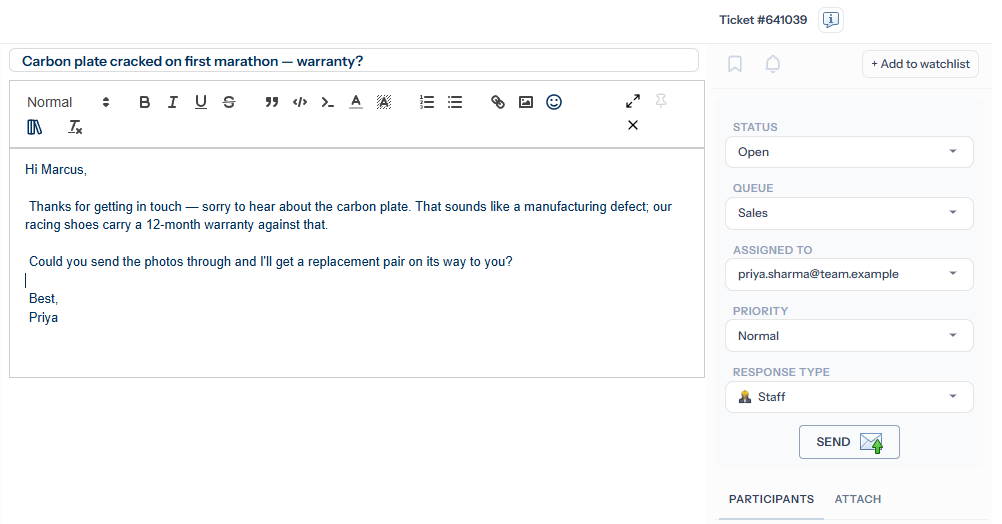
Writing
The composer is a rich-text editor. The toolbar covers headings, bold/italic/underline/strikethrough, blockquotes, code blocks, links, lists, colour, emoji, and stock-response insertion. Drag images into the body to inline them. To attach a file, open the Attach tab at the bottom of the side panel to reveal the dropzone, then drag files in or click to pick them.
Choosing a response type
Before sending, you must pick a response type. There are three; the two you will use most often are Public and Staff:
- Public — the message is visible to the customer (and any other public participants) on the ticket page; participants are notified.
- Staff — an internal note. Only your colleagues see it.
- External — a message visible to external participants; typically used when you wrap a ticket up.
Response types covers these in detail.
Sending
The post button below the side-panel fields reads Send when you have typed something in the body, or Save when the body is empty but you have changed an attribute (queue, assignee, priority, etc.) — the latter just persists the attribute change without sending anything. If something prevents sending — missing subject, missing response type, hashtags that need confirmation — the button shows the reason instead.
After sending, your reply is appended to the conversation, the ticket’s last-updated time refreshes, and any participants outside your team are notified.
Cancelling
The × in the toolbar closes the composer. If you have unsent content, Tickiti asks whether to save it as a draft or discard it.